Chicago leaders have approved an ordinance to broaden a program that tickets drivers for blocking city bus and bike lanes, according to multiple reports.
Here’s a breakdown of the measure and what it means for you.
City expanding Smart Streets program citywide, making camera enforcement permanent

Chicago City Council unanimously voted Wednesday, October 14, to expand the existing Smart Streets pilot program, according to Ald. Daniel La Spata’s (1st) office.
The traffic safety initiative first took effect in 2024, and was scheduled to expire in December 2026 before Wednesday’s vote was passed.
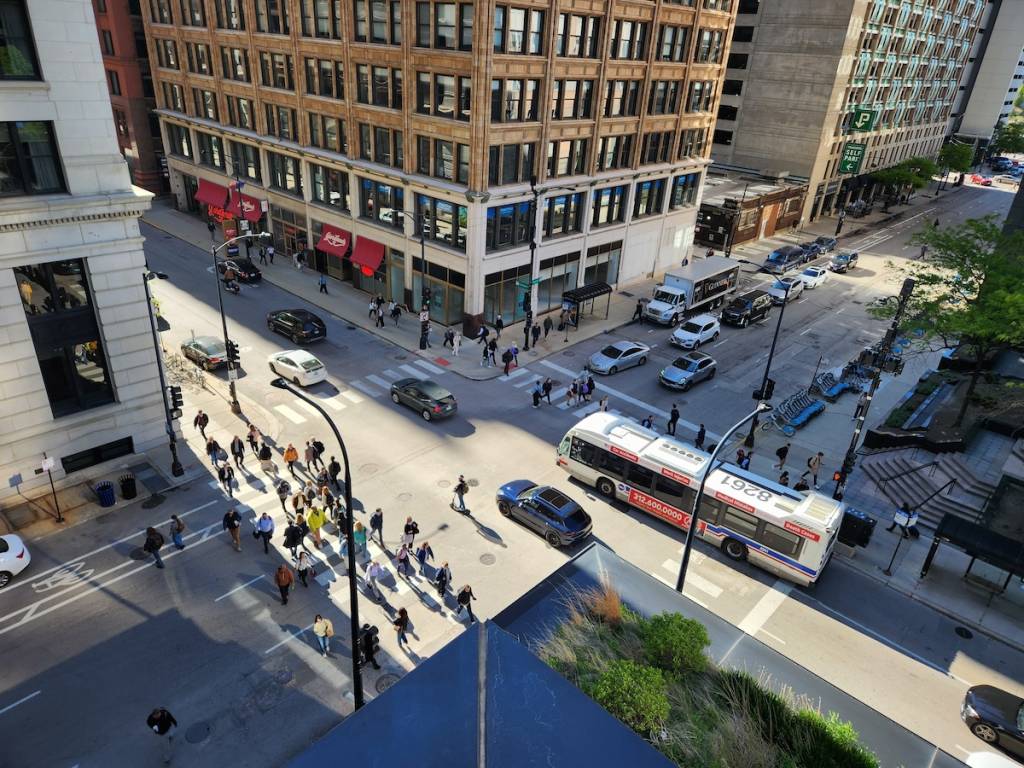
The program utilizes mounted cameras on Chicago Transit Authority (CTA) buses and city vehicles to document drivers illegally blocking bike and bus lanes, according to the Department of Finance.
Drivers receive a warning for their first violation, and fines for subsequent offenses, according to the CTA.
The program issues a range of fines for different violations:
- Standing, parking, or other use of bus lane – $90
- Parking/standing on bicycle path – $250
- Street cleaning – $50
- Parking/standing in a bus stop – $100
- Expired meter (non-Central Business District) – $50
- Expired meter (Central Business District) – $70
- Nonpayment/noncommercial vehicle parking in a commercial loading zone – $140
Smart Streets to expand in phases through 2028

Currently, the Smart Streets program applies to the areas of Chicago bound by Irving Park Road, Ashland Avenue, Archer Avenue, and 26th Street.
Alds. Vasquez (40th) and La Spata (1st) introduced the ordinance to expand Smart Streets citywide in September.
Under the ordinance, the program will permanently expand to the entire city of Chicago in three phases over the next two years:
- Phase 1: Foster-California-Pershing expansion to take effect between January 2027 and June 2027.
- Phase 2: Devon-Pulaski-51st Street to take effect between July 2027 and December 2027.
- Phase 3: Program will expand to the rest of the city between January and December 2028.
The Smart Streets program has proved effective in correcting driver behavior, according to Ald. La Spata’s (1st) office.
Data shows that 84% of drivers issued a warning did not go on to receive a ticket, while 70% of drivers who received one ticket did not receive a second.