The United States Army is scheduled to execute two controlled detonations on Friday, November 20 near the Illinois-Iowa border, according to a public advisory released by the U.S. Army.
The detonations are described as a “controlled safety operation,” in order to dispose of 5 tons of explosive materials deemed unfit for usage, including the chemical lead azide.
The army has confirmed the detonations will cause a dust plume containing lead which could cover surrounding areas.
Here’s everything to know about the operation, which areas may be impacted by the plume, and your questions answered.
When and where are the detonations happening?
The detonations will take place at the Iowa Army Ammunition Plant, located outside of Middletown, Iowa, just over 4 hours from Chicago.
The detonations are scheduled to take place at approximately noon.
Are any evacuation orders in place?
The U.S. Army is asking Middletown, Iowa residents to vacate the area between 8 a.m. and 2 p.m. local time.
What impact will the detonations have on the surrounding areas?

According to the army advisory, the detonations are expected to cause temporary noise, ground vibrations, and a dust plume containing “some lead,” a material which is toxic to humans and animals.
Nearby residents will likely hear loud noises, feel ground vibrations, and may see the dust plume.
The detonations also have the potential to cause localized window damage, according to the advisory.
What are the public health concerns related to the detonations?

The U.S. Army has identified two areas of public health concern related to potential lead exposure from the detonation plume, out of an “abundance of caution.”
The potential methods of exposure include:
- Lead exposure from inhaling air after the detonation.
- Lead exposure from dust on surfaces.
The U.S. Army notes that children under the age of 6 are especially vulnerable to lead exposure. Pregnant women and other populations are also particularly vulnerable to lead exposure, according to the CDC.
What areas will the plume impact?
According to maps released on Tuesday, November 17, the plumes will impact areas in Southeastern Iowa near the Mississippi river and Illinois-Iowa border.
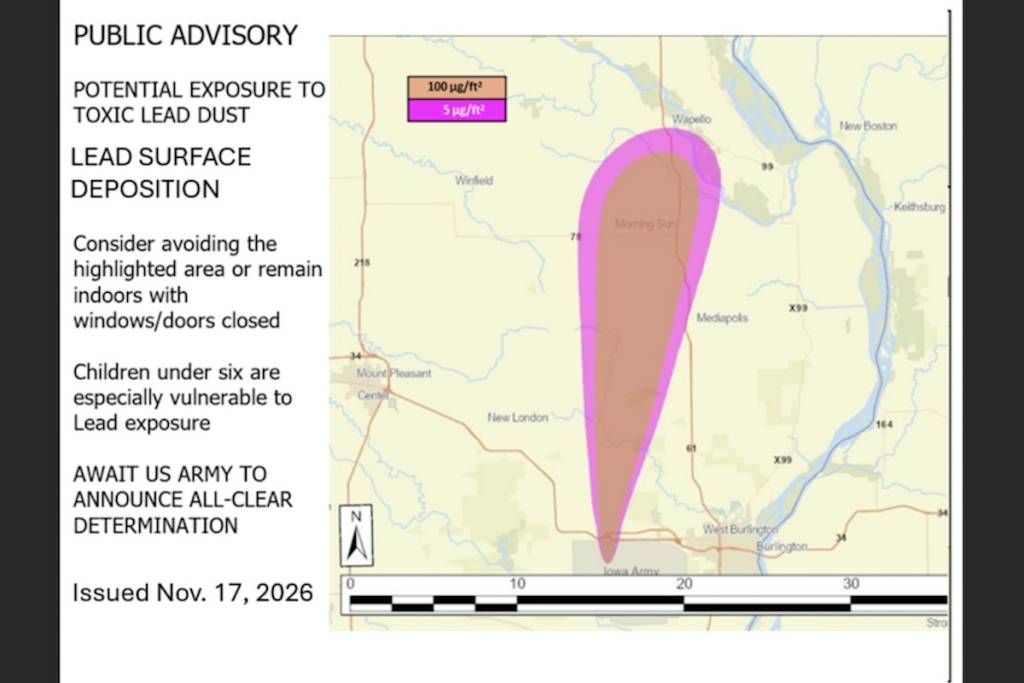
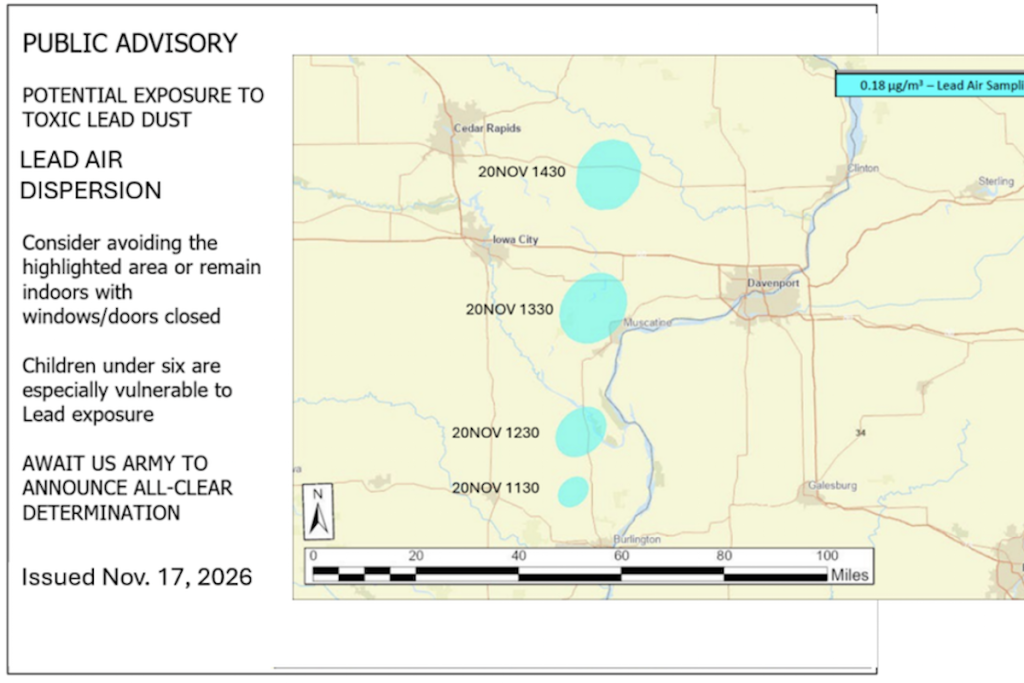
The maps show areas where exposure to lead particles via airborne inhalation or surface contact is possible.
What measures are being taken to ensure the safety of the public and minimize the impact of the detonations?

The U.S. Army has worked with the Environmental Protection Agency (EPA) to carry out the detonations safely and mitigate the impact of the dust plume.
The army has followed strict EPA permit requirements that mandate preventative protocol like soil wetting.
Soil wetting is a containment process wherein water is sprayed onto soil in order to weigh down hazardous dust particles and prevent them from becoming airborne.
Where can residents take shelter during the vacate order?
Those who need a safe place to wait out the vacate order are invited to the Armed Forces Reserve Center at 16815 Dmc Highway 34 in Middletown, IA.
Residents are welcome to bring their pets along in secure containers or on leashes.
Refreshments will be available. Guests will also have access to a gym and classrooms.
What else can residents who reside or work in the area do to stay safe?
The U.S. Army has released the following safety guidelines for those who reside or work in the impacted areas:
- Those who cannot evacuate should remain indoors during the exposure period between 8 a.m.—2 p.m.
- Residents sheltering indoors should secure all windows, exterior doors, and other openings.
- Minimize outdoor air intake, place HVAC systems in recirculation mode, and maximize indoor air filtration during the potential exposure period.
- Avoid travel within the affected area during the potential exposure period.
- Wet-clean surfaces that children may come into contact with.
Will the plume impact Chicago?

The U.S. Army’s advisory does not include any risk of lead particle exposure for the Chicago region related to the detonations.
For more information, click here.